Robotic-Assisted Knee Replacement
What robotic assistance actually changes in a knee replacement, when the accuracy genuinely matters clinically, and how to weigh the added cost.
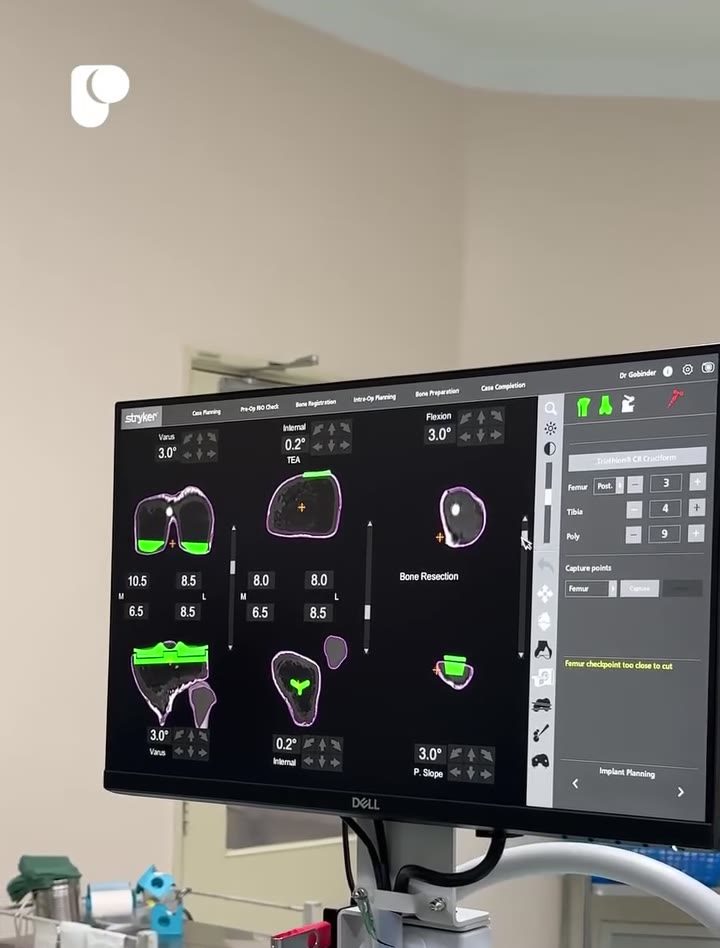
Robotic assistance is one of the most heavily marketed things in orthopaedics and one of the least clearly explained. This page tries to be specific about what it changes and what it does not.
What it is
A planning and execution system. Imaging of your knee, often a CT scan, is used to build a three-dimensional plan for implant size, position and alignment. During surgery the system tracks the position of your leg and the instruments, and constrains or guides the bone preparation so that what was planned is what is achieved.
What it changes
- Accuracy of implant position and limb alignment against a plan
- Intra-operative measurement of ligament balance through the range of movement, so adjustments are made against numbers rather than feel alone
- Pre-operative planning from your own anatomy rather than standard instrumentation
What it does not change
- The implant itself
- The incision and the fundamental surgical approach
- The rehabilitation you will do afterwards
- The surgeon’s judgement, which remains the determining factor
- The risks of the operation
Where the case for it is strongest
- Significant varus or valgus deformity
- Unusual anatomy, or bone that has been previously operated on
- Retained hardware from earlier surgery or fracture
- Partial knee replacement, where positioning tolerances are tighter
Where the knee is straightforward and the surgeon is experienced with conventional instrumentation, the accuracy gain is smaller and the case is weaker.
The cost
Robotic assistance carries a premium over conventional instrumentation. It is a real and knowable figure, so ask for it in writing along with the rest of the itemised estimate rather than accepting a single all-in number.
For context on what a knee replacement costs in Malaysia generally, the insurance industry’s own claims data puts a typical total knee replacement bill at up to RM33,400 with an average stay of about four days. The cost guide sets out where that figure comes from and what any quoted package tends to exclude.
If you intend to claim on insurance, read the insurance guide first. Advertised fixed packages are commonly for self-paying patients only, so the figure you have seen may not be the one that applies to you.
The question to ask
Not “is robotic better”, which invites a marketing answer. Instead:
What is it about my knee that makes this worth the extra cost?
A good answer refers to your imaging, your deformity and your anatomy. An answer that only describes the technology has not answered the question.
Common questions
Does a robot perform the surgery?
No. The surgeon performs the operation. The system builds a plan from your imaging and then constrains or guides the bone preparation so that the implant is positioned as planned. It is an accuracy tool, not an autonomous device, and the surgeon's judgement about alignment, ligament balance and implant choice is unchanged.
How much more does it cost in Malaysia?
It carries a premium over conventional instrumentation, and the size of it is a fair question to put directly to the hospital treating you. Ask for it as a line on a written itemised estimate rather than as part of a single all-in figure, and ask what specifically about your knee makes the accuracy worth paying for. For context on total cost, the insurance industry's claims data puts a typical knee replacement bill at up to RM33,400.
Is it covered by insurance?
Ask your insurer in writing before agreeing to it. Insurers may treat robotic assistance as a technology surcharge rather than a medically necessary component, in which case the difference falls to you. Note also that hospital package prices generally do not apply to patients using a guarantee letter.
When does the accuracy actually matter?
Most clearly where accurate alignment is hardest to achieve by conventional means: significant deformity, unusual anatomy, previous surgery or retained hardware, and partial replacements where implant positioning is less forgiving. In a straightforward knee, a well-performed conventional replacement is a well-performed replacement.
References
Related reading
Total Knee Replacement
What a total knee replacement involves, who it suits, what recovery asks of you, and the risks and alternatives worth understanding before deciding.
Knee Replacement Cost in Malaysia: A Sourced Guide
What a total knee replacement actually costs in a Malaysian private hospital, where the money goes, and why the figure you were quoted may not be the figure you pay.
Partial or Total Knee Replacement: How to Decide
How surgeons choose between a partial and a total knee replacement, what each involves, how long they last, and the questions to ask if only one was offered.